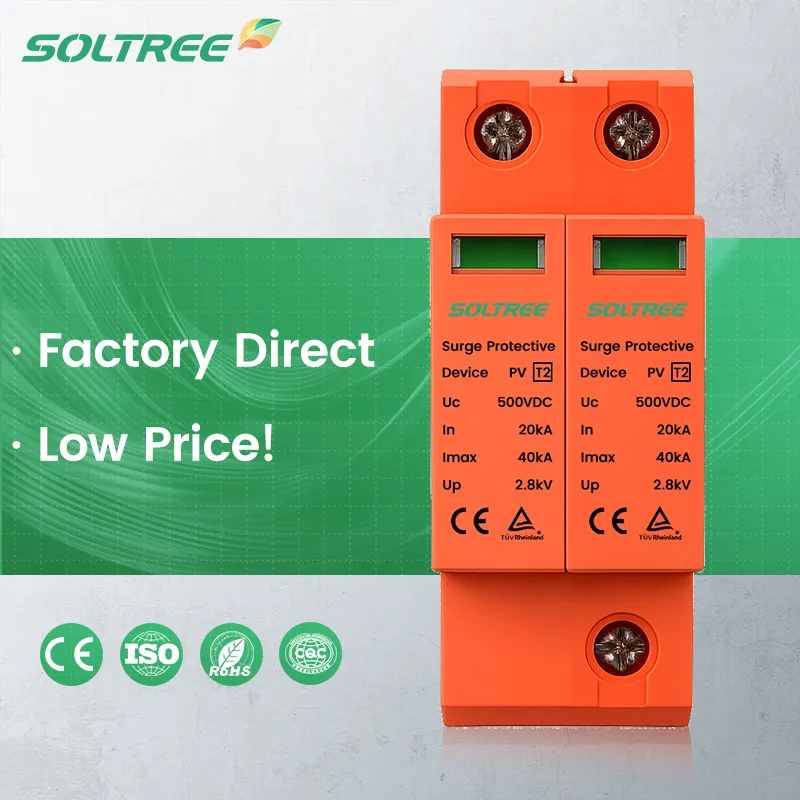
Soltree Logo
EN

Solar PV Surge Protection

DC Surge Protectors for Solar PV Systems, 600V 2P & 1000V 3P

Type 2 DC SPDs that protect inverters, PV modules and combiner boxes against induced lightning and switching overvoltage. Factory-direct from Soltree, with CE, TÜV and CB certification and OEM from 100 pieces.

Type 2 / Class II

For induced lightning and switching surges

In 20kA / Imax 40kA

8/20μs discharge ratings

600V 2P / 1000V 3P

Two core PV configurations

Pluggable design

35mm DIN rail mounting

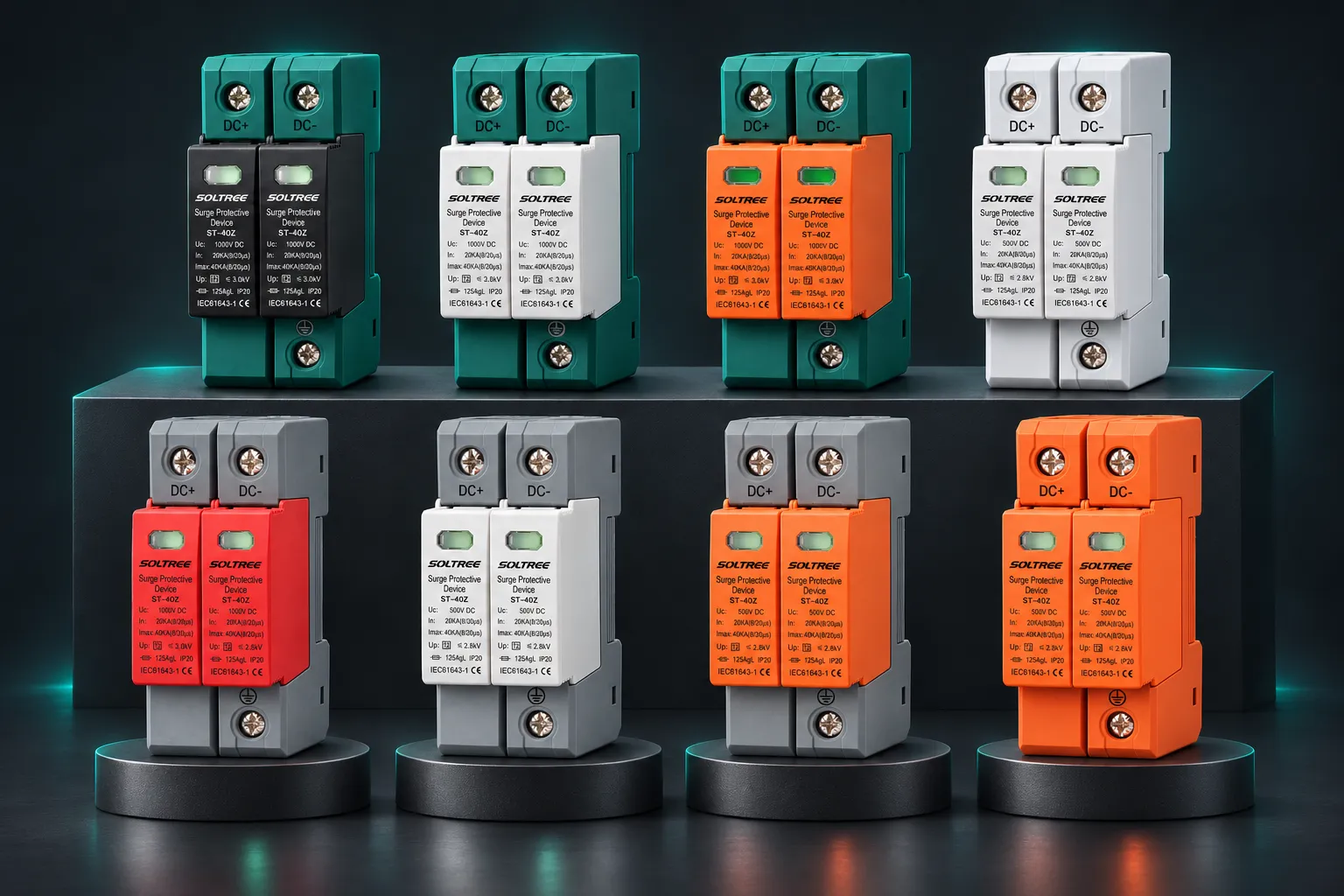
DC SPD range Type 2
Soltree DC surge protector range in eight housing and module color combinations

CE · TÜV · CB certified · MOQ 100 pcs · 7-day lead time · Custom color, logo and packaging

How it works

What Does a DC Surge Protector Do?

A DC surge protector (SPD) sits between the PV conductors and earth. Under normal operation it stays at high impedance and has no effect on the system. When a surge appears on the DC line, it responds within 25 nanoseconds, diverts the surge current to earth and limits the voltage that reaches the inverter. Once the surge has passed, it returns to high impedance automatically.

  1. 01

    Normal operation

    High impedance. No leakage, no effect on power generation.

  2. 02

    Surge event

    Conducts within ≤25ns and diverts surge current to earth.

  3. 03

    Recovery

    Returns to high impedance and stays ready for the next event.

Product range

DC Surge Protector Product Range

Choose between two STD-40-PV Type 2 models: 600V 2P and 1000V 3P. Each has a dedicated product page with electrical specifications, installation information and wiring diagrams to help you review the right configuration for your project.

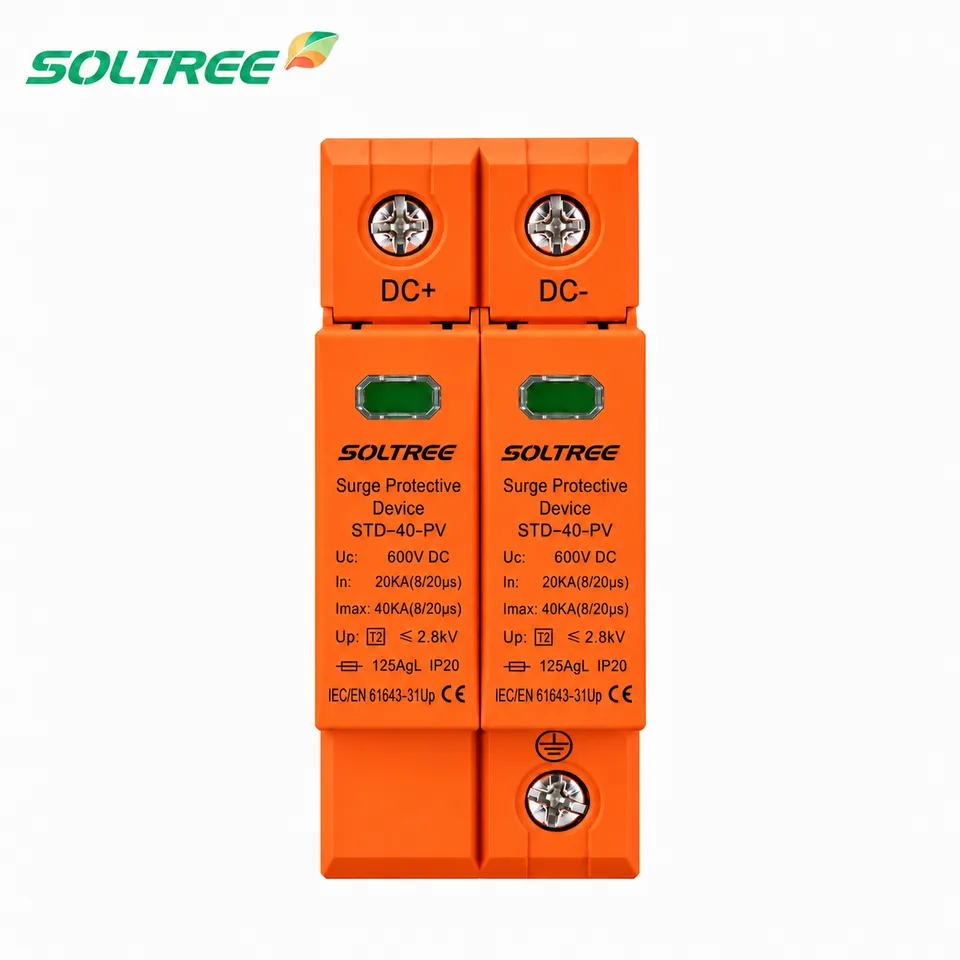
Soltree Type 2 / 600V DC / 2P STD-40-PV DC surge protector

Type 2 / 600V DC / 2P

Type 2 600V 2P DC Surge Protector SPD STD-40-PV

A 2-pole Type 2 DC SPD for 600V PV circuits, installed in a string combiner box or near the inverter DC input. Review its specifications, 2P drawings and combiner-box installation example on the product page.

Configuration
600V DC / 2P / Type 2
Surge ratings
In 20kA / Imax 40kA (8/20μs)
Maintenance
Replaceable plug-in MOV modules
Product guide
Specifications, wiring, installation and 2P dimensions
View 600V 2P details
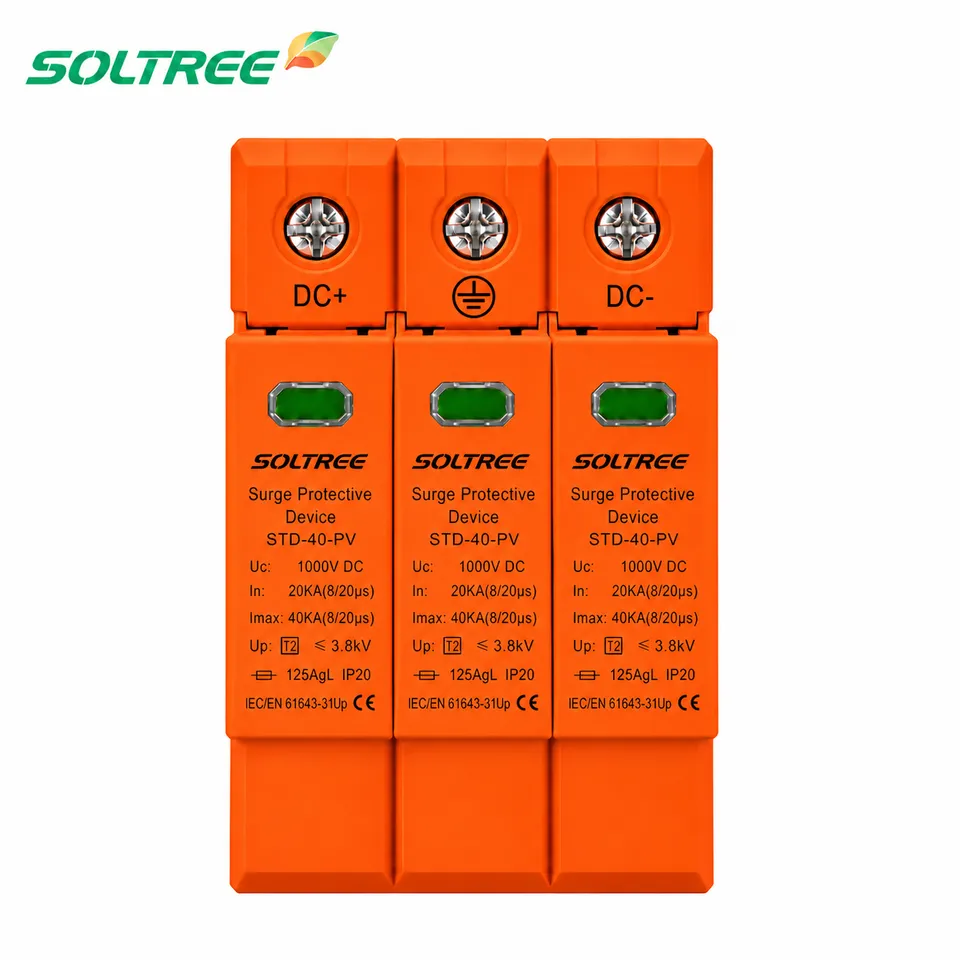
Soltree Type 2 / 1000V DC / 3P STD-40-PV DC surge protector

Type 2 / 1000V DC / 3P

Type 2 1000V 3P DC Surge Protector SPD STD-40-PV

A 3-pole Type 2 DC SPD for 1000V PV circuits, for use at the string combiner box or inverter DC side. Review the electrical ratings and wiring diagram against your PV circuit and earthing arrangement before ordering.

Configuration
1000V DC / 3P / Type 2
Surge ratings
In 20kA / Imax 40kA (8/20μs)
Maintenance
Replaceable plug-in MOV modules
Product guide
Specifications, wiring, installation and dimensions
View 1000V 3P details

Selection

DC SPD Selection Table

Compare pole counts, PV voltage ratings (Ucpv), protection levels (Up) and discharge current ratings for the 600V 2P and 1000V 3P STD-40-PV models. Use this table to shortlist a configuration, then follow the three-step guide below to review your selection.

Model Poles Ucpv (V DC) Up (kV) In (kA, 8/20μs) Imax (kA, 8/20μs)
STD-40-PV 600V 2P 600 2.8 20 40
STD-40-PV 1000V 3P 1000 3.8 20 40

How to Choose a DC Surge Protector in 3 Steps

  1. STEP 1

    Match Ucpv to the maximum string voltage

    Ucpv must be equal to or higher than the highest open-circuit voltage the string can reach. Voc rises as temperature falls, so calculate it at the lowest expected site temperature, not at 25°C.

    Compare the calculated maximum string voltage with the selected model: 600V DC for the 2P version or 1000V DC for the 3P version. If the maximum exceeds 1000V, neither model on this page is suitable. Use the module temperature coefficient and site design data for the calculation.

    Never choose an SPD whose Ucpv is below the maximum string voltage. It will conduct during normal operation, overheat and fail.

  2. STEP 2

    Choose the protection type

    Both models on this page are Type 2 / Class II SPDs for induced lightning and switching surges, with 8/20μs discharge ratings. Confirm that your project requires Type 2 protection before choosing between the 600V 2P and 1000V 3P models.

    If the site design requires Type 1, combined Type 1+2 or Type 3 protection, have your designer specify the appropriate device and coordination. These two models are Type 2 only.

  3. STEP 3

    Read In and Imax correctly

    • In (nominal discharge current, 20kA): the surge current the SPD withstands repeatedly. It is tested with repeated impulses, and after the test the varistor voltage must stay within ±10%. This is the figure that indicates service life.
    • Imax (maximum discharge current, 40kA): the single largest surge the SPD can divert once. It is a safety limit, not a working rating. After an Imax-level event, the unit should be inspected and usually replaced.
    • Pole count: match the protection circuit to the PV wiring diagram and earthing arrangement. Pole count alone does not confirm a Y circuit or the number of independent MPPT inputs protected.

Build quality

What's Inside: Materials You Can Specify

Two SPDs with the same datasheet can perform very differently after a few seasons outdoors. The difference is in the materials. Soltree lets you specify each one.

Component Our premium option Low-cost alternative on the market Why it matters
Varistor chip 34S square MOV (34×34mm), epoxy encapsulated Smaller round discs, bare chips Larger chips carry more surge energy; encapsulation resists moisture and flashover
Contact pins Brass (pluggable type) Iron Better conductivity, spring force and corrosion resistance
Internal conductor Pure copper Brass or iron Lower resistance, less heat during surge discharge
Base terminals Copper Iron Stable clamping and lower contact resistance over time
Housing Flame-retardant PC, UL94 V-0 V-1 / V-2 grade plastics V-0 is the highest flammability rating in its class

All materials above are available as options. Tell us your target market and price level, and we will recommend a configuration.

Testing & certification

Tested to the Standard, Certified for Export

Certifications
CE, TÜV and CB
Standard
IEC 61643-31 / EN 61643-31 (SPDs for photovoltaic installations)
CE
Low Voltage Directive 2014/35/EU, RoHS compliant

Type tests performed to the standard

  1. Operating duty test at In (8/20μs): varistor voltage change within ±10% after testing
  2. Imax impulse test: no failure, no ignition
  3. Thermal stability test under sustained overvoltage
  4. Short-circuit withstand test

Requirements: no carbonisation, no fire, no accessible live parts after testing

Applications

Where Our DC SPDs Are Installed

Every PV project has a different layout, from a compact rooftop system to a field of string combiner boxes. Find your application below and the project details to share for selection support. Voltage rating and pole configuration depend on the actual PV circuit and wiring diagram.

Residential rooftop PV

For the PV DC side of home solar installations, with protection planned at the combiner box or near the inverter input. Allow access for inspection and replacement, even in compact enclosures.

Selection focus
Maximum string voltage, enclosure space and service access.

C&I rooftop

For factories, warehouses and commercial roofs with multiple PV strings. Plan around the combiner and inverter locations, with a layout that supports routine inspection and scheduled maintenance.

Selection focus
String layout, inverter locations and existing lightning protection.

Ground-mount power stations

For field arrays using string combiner boxes or distributed inverters. Review protection locations alongside the DC cable routes and the site earthing and lightning protection design.

Selection focus
DC cable lengths, system voltage and the site protection plan.

Energy storage & hybrid inverters

For the solar-input side of hybrid inverter systems. Review the independent MPPT circuits against the inverter wiring diagram; battery-side protection requires a separate compatibility assessment.

Selection focus
Inverter model, MPPT count and PV-side wiring diagram.

RV & off-grid solar

For compact PV distribution boxes in mobile and standalone solar systems. Review the actual array voltage and available mounting space, rather than choosing by installation size alone.

Selection focus
Array voltage, controller model and available DIN rail space.

Need SPDs already wired?

Our PV combiner boxes ship with DC SPDs and breakers pre-installed. Share your string layout, inverter model and enclosure requirements to discuss a ready-wired configuration for your project.

Browse PV combiner boxes

Installation planning checklist

Have a qualified installer confirm the final arrangement against the selected model's instructions and applicable local requirements.

  • Connection layout

    Keep SPD connections short and direct. Check routing and permitted lead lengths against the installation instructions.

  • Conductors & terminals

    Use the conductor sizes and tightening torques specified for the selected model.

  • Backup protection

    Confirm whether backup protection is required and use the DC-rated device specified in the product documentation.

  • Inspection & replacement

    Keep the status window visible and leave service access. Follow the model instructions when the indicator calls for replacement.

For distributors & system builders

OEM and Private Label, from 100 Pieces

Build a DC SPD range around your brand, from housing color and product labels to retail packaging. Share your target specification, market and quantity so the product configuration and brand presentation can be discussed together.

Soltree DC surge protector in a custom housing color

A consistent look across your product range

Discuss housing color, on-product branding and packaging together for a coordinated presentation under your own label.

MOQ
100 pcsper model
Lead time
7 days including custom orders

Final lead time depends on the agreed configuration, artwork and quantity and is confirmed with your quotation.

Housing color

Match the housing to your brand or product family. Share a color reference and the models you want to include.

Logo & product labels

Add your brand to the housing and labels. Provide your logo artwork, model naming and required label information for review.

Boxes, inserts & cartons

Discuss custom packaging for your sales channel. Share the box artwork, pack quantity and any carton marking requirements.

Product configuration

Discuss voltage rating, pole configuration, structure and material options around your application and budget. Confirm the electrical specification before the order.

From your brief to an agreed order

  1. 01

    Share your requirements

    Send the target model or application, quantity, destination market and branding requirements. Include a wiring diagram if the configuration needs review.

  2. 02

    Review specification & artwork

    Review the proposed electrical configuration, color, label content and packaging details together with the quotation.

  3. 03

    Confirm the order & schedule

    Confirm the agreed specification, artwork, quantities and lead time before the order proceeds. Keep the approved details as the reference for future orders.

Have a specification or packaging brief ready? Include it with your enquiry so we can discuss the details with your pricing request.

Request OEM Pricing

Before you specify

DC Surge Protector FAQs

Find answers on PV surge protection, configuration and maintenance, plus the details to prepare for an OEM order or project quotation.

Selection & installation

Do I need a surge protector for my solar system?

A PV surge protection plan should consider the DC side as well as the AC side. Whether protection is required and which type to use depend on local installation rules, site exposure and the lightning protection design. Have your installer confirm the requirements for your project.

What is the difference between a DC SPD and an AC SPD?

Use an SPD specifically rated for the circuit. PV DC and AC devices differ in their voltage ratings, internal arrangements and test requirements. An AC mains SPD is not a substitute for a PV-rated DC SPD.

What Ucpv do I need for a 1000V system?

Choose a Ucpv equal to or higher than the maximum PV string open-circuit voltage. Calculate that voltage at the lowest expected site temperature: if it stays within 1000V, a 1000V-rated SPD can fit; if it exceeds 1000V, neither of the two models on this page is suitable. The protection level Up and circuit arrangement must also suit the equipment. Do not select a voltage class from the inverter nameplate alone. Share the string calculation and inverter data for selection support.

Type 1 or Type 2 for solar?

Most rooftop and ground-mount PV systems without an external lightning protection system use Type 2 SPDs, which address induced and switching surges. Where lightning currents can enter the installation, Type 1 or combined Type 1+2 protection may be needed. The external lightning protection system and its separation distance affect this decision. Both STD-40-PV models shown on this page are Type 2; have your designer confirm the protection concept.

Where should the DC SPD be installed?

Common locations include PV combiner boxes and the DC side near the inverter. Cable lengths, routing and the lightning protection design determine whether additional protection points are needed. Have your installer confirm the locations and connection layout using the selected device instructions.

What is the difference between 2P and 3P DC SPDs?

Pole count alone does not define the protection circuit. Compare the wiring diagrams, protected modes and earthing arrangement. A 3P label does not by itself confirm a Y circuit or suitability for a particular system. Send your inverter model and DC wiring diagram so the configuration can be reviewed.

Maintenance & ordering

Does an SPD need replacing after a lightning strike?

Not automatically after every event. Check the status indicator and have the device and its connections inspected after a significant surge. Replace a failed unit as instructed by the manufacturer. For a pluggable model, confirm the replacement module matches the base and that the base remains serviceable.

Can you supply private label SPDs?

Yes. Housing color, logo, labeling and packaging can be customized, with MOQ starting at 100 pieces per model. Share your artwork, target configuration and quantity. Confirm the final specification and delivery schedule with your quotation.

What information should I send for a quotation?

Send the inverter model, string layout, maximum string voltage if known, quantity and destination market. Include your wiring diagram, required documentation and any color, logo or packaging requirements. If the configuration is still open, tell us which details need review.

Can you supply SPDs in a pre-wired PV combiner box?

Yes. Our PV combiner box range includes configurations with DC SPDs and breakers pre-installed. Share the string count, inverter model and enclosure requirements so the available configuration can be checked against your project.

Need help choosing a configuration?

Send your inverter model, wiring diagram and quantity with your enquiry.

Ask about your project

Get a quote

Tell Us About Your PV Project

Send us your system voltage, pole count and quantity. Our engineers will recommend a configuration and reply with pricing.

  • 01 — Maximum string voltage and system type
  • 02 — Selected model: 600V 2P or 1000V 3P
  • 03 — Quantities, destination and target certifications
  • 04 — Color, logo, packaging or sample requirements

Tell us about your DC SPD project

Chat with Soltree

Product selection & quotations

Tell us your product requirements. Our team will help you find the right solution.