
AC Miniature Circuit Breakers (MCB)
Compare STA-63, STB-63 and STC-63. Choose STB-63 for standard 6kA applications, STC-63 when 10kA breaking capacity is required, and STA-63 for economy C/D-curve configurations.
Three focused series
Economy, standard and high breaking
1P–4P options
Confirm the required isolation arrangement
4–10kA range
Match the prospective fault current
B, C and D curves
Verify the selected series and load
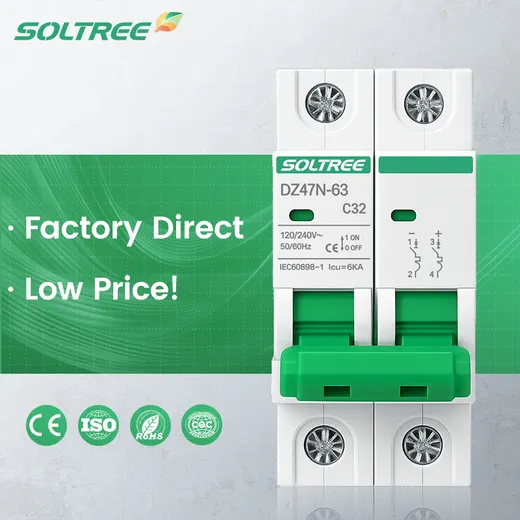
2P AC MCB
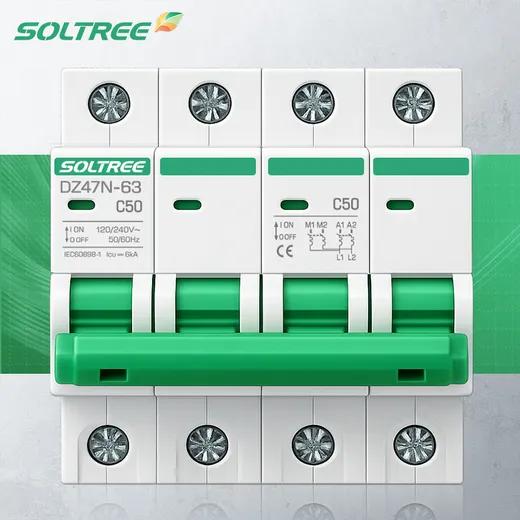
4P AC MCB
Select by circuit type, voltage, fault level and pole arrangement.
Understanding MCBs
A small device with
a critical job.
A miniature circuit breaker (MCB) automatically opens a circuit when current exceeds its protection limits. It helps protect wiring and connected equipment from the effects of overloads and short circuits.
Overload protection
The thermal release responds to sustained excess current, according to the breaker's time-current characteristic.
Short-circuit protection
The magnetic release responds rapidly to high fault currents within the breaker's specified operating limits.
Need earth leakage protection? An MCB should be paired with the appropriate residual current protection, or an RCBO selected for the circuit.
Find your configuration
AC protection, from 1P to 4P.
Compare the listed AC pole options below. Each model links to its full product specifications; the STA, STB and STC series comparison follows in the selection section.
AC miniature circuit breakers
For AC distribution boards and final circuits.

MCB-AC-1P
1P AC MCB
- Rated voltage
- 120V / 230V AC
- Breaking capacity
- 4.5 kA, 6 kA Customed
View specifications
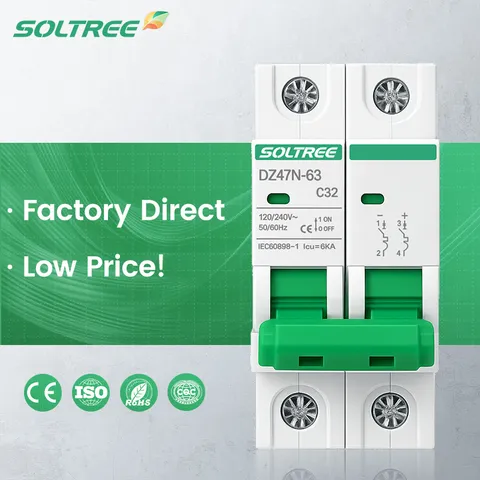
MCB-AC-2P
2P AC MCB
- Rated voltage
- 120V / 230V AC
- Breaking capacity
- 4.5 kA, 6 kA Customed
View specifications
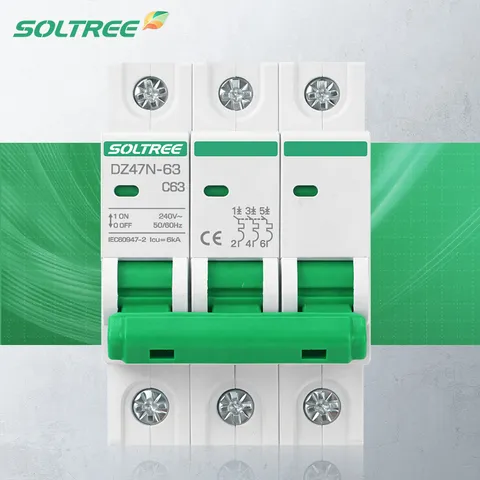
MCB-AC-3P
3P AC MCB
- Rated voltage
- 120V / 230V AC
- Breaking capacity
- 4.5 kA, 6 kA Customed
View specifications
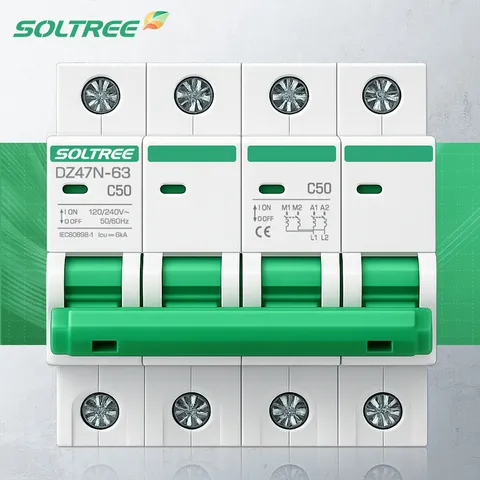
MCB-AC-4P
4P AC MCB
- Rated voltage
- 120V / 230V AC
- Breaking capacity
- 4.5 kA, 6 kA Customed
View specifications
Working on the PV or battery DC side? Compare the dedicated DC range and its selection requirements.
Explore DC MCBs
Compare STA-63, STB-63
and STC-63
Compare the published electrical ratings, application scope and technical documents for the three series.
| Selection factor |  STA-63View this series | STB-63View this series | STC-63View this series |
|---|---|---|---|
| Product positioning | Economy | Standard | High breaking |
| Rated current | 6–63A | 1–63A | 1–63A |
| Number of poles | 1P, 2P, 3P, 4P | 1P, 2P, 3P, 4P | 1P, 2P, 3P, 4P |
| Trip curves | C / D | B / C / D | B / C / D |
| Breaking capacity | 4–6kA by curve and current C curve 6–32A: 6kA · C curve 50–63A: 4kA · D curve: 4kA | 6kA | 10kA |
| Rated voltage | 230V AC (1P); 400V AC (2P–4P) | 240/400V (1P, 2P); 400V (2P–4P) | 240/400V (1P, 2P); 400V (2P–4P) |
| Applicable standard | IEC 60898 | GB/T 10963.1, IEC 60898-1 | GB/T 10963.1, IEC 60898-1 |
| Recommended use | Cost-sensitive C/D-curve distribution where the exact breaking-capacity band is verified. | General residential, commercial and light-industrial distribution. | Distribution circuits requiring a declared 10kA breaking capacity. |
| Datasheet | Open PDF ↗ | Open PDF ↗ | Open PDF ↗ |
| Product page | View details → | View details → | View details → |
Application planning
AC protection for building and equipment circuits.
Tell us where the breaker will be used. We can help identify a configuration to review against your project requirements.
Discuss Your Project ↗Building power distribution
AC MCBs for compatible residential and commercial final circuits, with pole arrangements selected for the supply and circuit design.
Commercial & light-industrial circuits
Review the load characteristic, trip curve and prospective fault current for distribution boards and final circuits.
Equipment & panel building
Compare AC current ratings, pole options and mounting requirements for the equipment circuit and its protection design.
For distributors & equipment builders
Your specifications.
Your MCB supply plan.
Build your enquiry around the models and quantities you need. Soltree's listed MCB range includes OEM and ODM options for branding and configuration.
- Product configuration
Confirm poles, ratings, trip curves and model availability. - Branding & packaging
Discuss logo, rating labels and packaging requirements. - Order preparation
Request samples, documentation, pricing and lead times.
Before you specify
AC MCB questions, answered.
What is an AC MCB?
An AC miniature circuit breaker protects a compatible AC circuit against overloads and short circuits. After the fault has been resolved, it can be reset rather than replaced like a fuse.
What is the difference between AC and DC MCBs?
AC and DC circuits have different arc interruption requirements. Choose a breaker explicitly rated for the circuit type and voltage. An AC-only breaker must not be substituted for a DC-rated breaker.
How do I choose the current rating and number of poles?
Start with the circuit type, maximum operating voltage, load current, conductor capacity and prospective short-circuit current. Select the pole arrangement and trip curve to suit the circuit design, wiring diagram and applicable installation requirements.
Does an MCB provide earth leakage protection?
A standard MCB protects against overloads and short circuits. Residual current protection requires an appropriate RCCB or RCBO. The protection devices must be coordinated for the installation.
Does this page also cover DC circuit breakers?
This page focuses on AC distribution. Our separate DC MCB page covers the listed DC models, PV and DC application planning, and the voltage and wiring information needed for selection.
Can Soltree supply private label MCBs?
OEM and ODM options are listed for the Soltree MCB range. Send your required ratings, branding, target market and quantities so we can confirm available configurations, documentation, samples and order terms.
Let's specify your AC MCB
Get the right configuration.
Request your quote.
Send your circuit requirements or bill of materials. Include the details below so we can prepare a relevant response.
- 01 — AC application, system voltage and frequency
- 02 — Rated current, poles and breaking capacity
- 03 — Quantities, destination and target standards
- 04 — Branding, packaging or sample requirements