

In 2025, electrical-cabinet fires caused more than USD 1.2 billion in industrial property losses globally — and most of those fires began in spaces no larger than a shoebox. A modern din rail aerosol fire extinguisher, often costing under USD 50 wholesale, can detect and suppress that same fire in under three seconds, before it ever reaches the cable trays.
If you import, distribute, or specify electrical fire-protection equipment, the case for adopting this category has rarely been stronger. The harder question is *where to source from*. Right now, China produces an estimated 60–70% of the world's din rail aerosol extinguishers across more than 80 active OEM factories. Quality varies. Pricing varies even more. Certifications can be a minefield.
This guide is the operating manual for buying din rail aerosol fire extinguishers from China in 2026. It walks through the technology, the specifications that actually matter, the certifications you cannot skip, the supplier red flags that should kill a deal, realistic pricing ranges, MOQ and lead-time expectations, and a representative EPC deployment that ties it all together.
Who this guide is for: importers, distributors, EPC procurement teams, and electrical engineers responsible for cabinet-level fire protection in switchgear, BESS, EV charging, telecom, data center, and rail applications.
Why Source Din Rail Aerosol Extinguishers from China
China's leadership in this category is not accidental. It sits on top of three converging supply chains, each of which is hard to replicate elsewhere.
A Vertically Integrated Chemical and Component Base
The active suppression agent in a condensed aerosol extinguisher — typically a potassium-salt formulation built around potassium nitrate, potassium carbonate, and proprietary stabilizers — is produced almost entirely within Chinese specialty-chemicals clusters in Shandong, Jiangsu, and Sichuan. The plastic and aluminum housings, the DIN 35 mm rail clips, the thermal-trigger glass bulbs, and the electric initiation modules are all sourced within a 500 km radius of the major assembly hubs in Zhejiang and Guangdong. A typical EU-based assembler, by comparison, imports 70–90% of these inputs — and pays a premium for it.
Cost Structure: 40–60% Lower Landed Cost
Independent benchmarking by sourcing consultancies in 2025 placed Chinese FOB prices at roughly 40–60% below comparable EU-manufactured units of equivalent specification. The largest contributors are labor cost on assembly and certification testing, mold and tooling amortization spread across millions of annual units, and direct access to upstream chemical suppliers. None of these are likely to compress meaningfully before 2028.
Manufacturing Depth and Certification Fluency
The top-tier Chinese factories now carry CE EN 15276, UL 2775, CCC, and frequently SASO, INMETRO, or KC certifications on the same product line — which means a single SKU can serve EU, North American, GCC, Brazilian, and Korean markets with only documentation differences. A decade ago this multi-market readiness was rare; today it is the baseline for any manufacturer worth shortlisting.
Risks You Must Manage
Sourcing from China is not without friction. The most common failure modes:
- Specification drift between sample units and bulk production
- Counterfeit or expired test reports sold by unaccredited labs
- MOQ creep at the contract stage versus quotation stage
- Hazardous-goods misclassification that delays customs
We address each of these in the supplier vetting section below.
What Is a Din Rail Aerosol Fire Extinguisher?
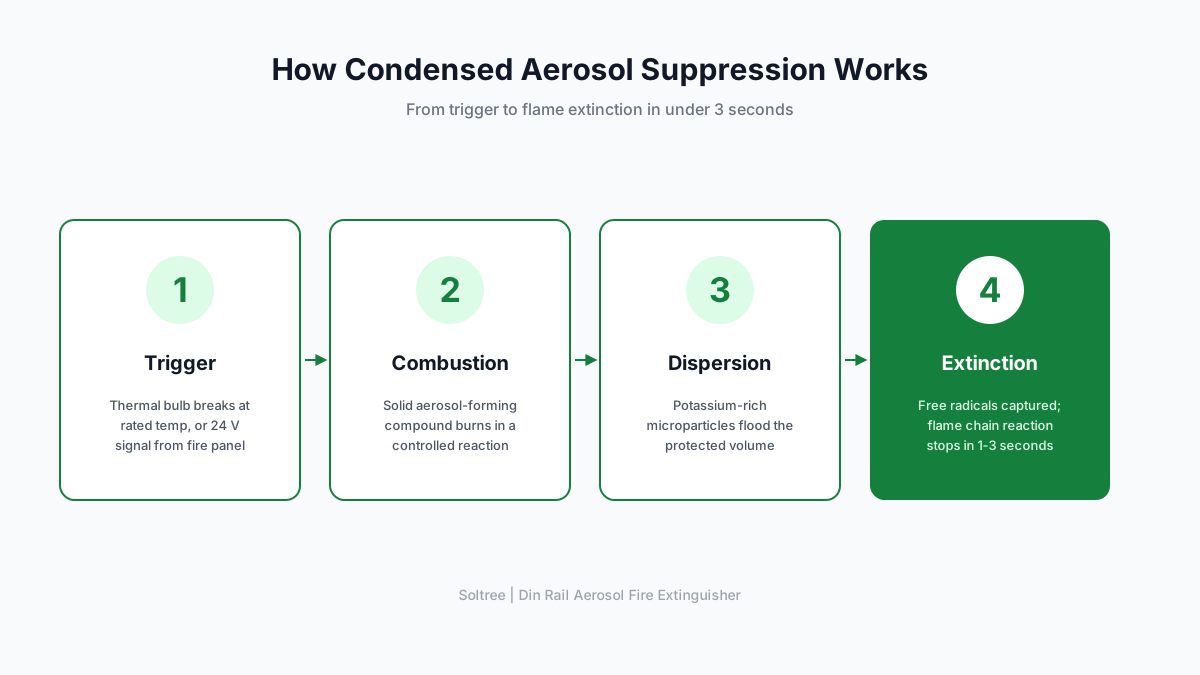
A din rail aerosol fire extinguisher is a self-contained, modular fire-suppression device designed to mount on the standard 35 mm DIN rail used inside low-voltage electrical enclosures. When activated, it discharges a cloud of microparticles — the "condensed aerosol" — that floods the protected volume and interrupts the chemical chain reaction of combustion at a molecular level.
How It Works in One Paragraph
When the trigger is activated (either by heat reaching the rated temperature on a thermal bulb, or by an electric signal from a fire panel), a solid aerosol-forming compound inside the canister combusts in a non-explosive, controlled reaction. This produces a fine mist of potassium-rich particles, suspended in inert gases. Those particles capture the free radicals (H, OH, O) that normally sustain a flame, ending the fire typically within 1–3 seconds in cabinet-sized volumes.
How It Differs From Traditional Suppression
| Method | Residue | Response time | Pipework | Cabinet-suitable |
|---|---|---|---|---|
| Water / sprinkler | High | 30+ s | Yes | No |
| Foam | High | 10+ s | Yes | No |
| CO2 | None | 5–15 s | Yes | Marginal (asphyxiation risk) |
| FM-200 / Novec 1230 | None | 5–10 s | Yes | Yes (but expensive) |
| Condensed aerosol (din rail) | Negligible | 1–3 s | No | Yes |
The four properties that make the din rail format dominant inside electrical cabinets are: no piping, no residue on energized equipment, second-level response, and a 10-year service life with effectively no maintenance.
Top Applications and Market Demand in 2026
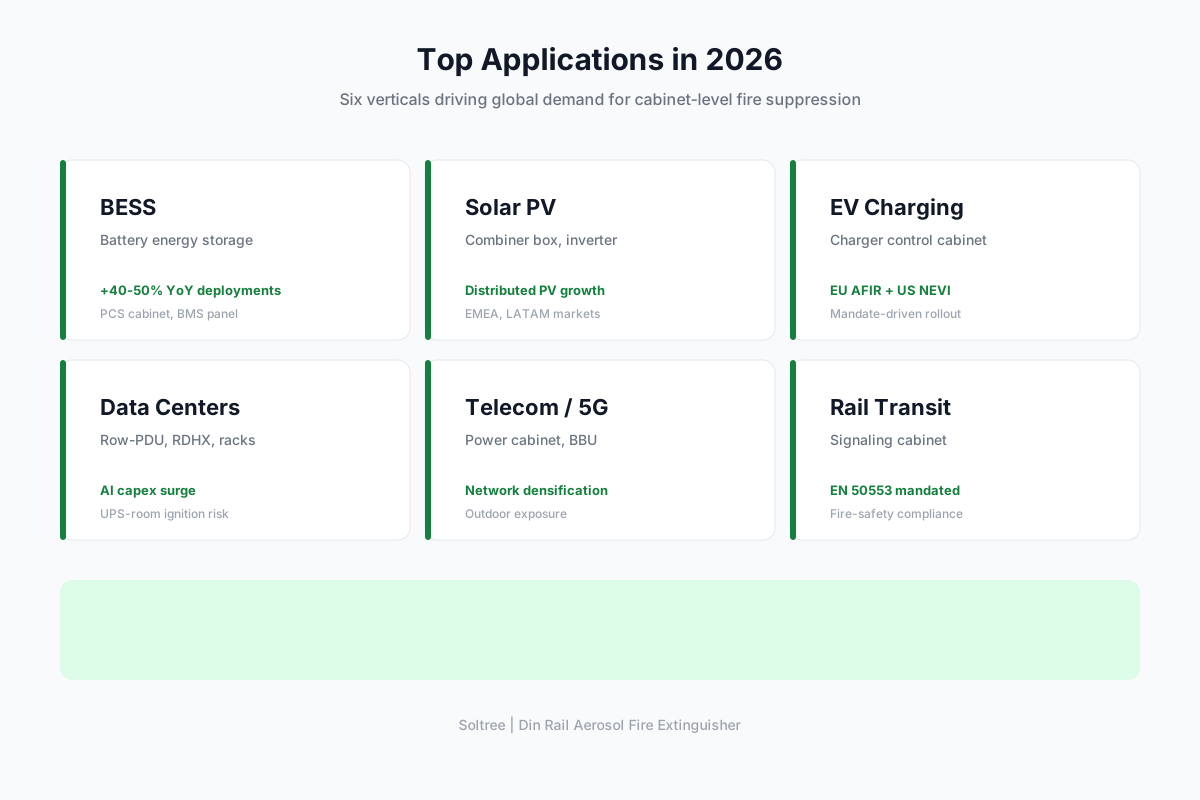
Three macro forces are pulling demand for din rail aerosol extinguishers upward in 2026: the global energy storage build-out, EV charging infrastructure mandates in the EU and North America, and AI-driven data center expansion. Below are the verticals where a typical Chinese manufacturer ships the highest volumes today.
| Vertical | Typical use case | 2026 demand driver |
|---|---|---|
| Battery energy storage (BESS) | PCS cabinet, BMS panel | Global BESS deployments forecast at +40–50% YoY |
| Solar PV | Combiner box, inverter cabinet | Distributed PV growth across EMEA, LATAM |
| EV charging | Charger control cabinet | EU AFIR mandate, NEVI rollout in the US |
| Data centers | Row-PDU, RDHX, rack-level | AI capex; UPS-room ignition cases |
| Telecom / 5G | Power cabinet, BBU shelter | Network density, outdoor cabinet exposure |
| Rail transit | Signaling cabinet | EN 50553 fire-safety compliance |
| Industrial automation | MCC, VFD enclosure | Aging installed base + insurance requirements |
| Marine / offshore | Switchboard cabinet | DNV / Lloyd's requirements for unmanned engine rooms |
| Building electrical | Main distribution panel | Insurer-driven retrofits |
Technical Specifications That Matter
The category looks deceptively simple — a small canister on a DIN rail. In practice, getting the specification right is the difference between a unit that suppresses an incipient fire and a unit that fires too late, fires under-dosed, or never fires at all. The seven parameters below are the ones any serious procurement file should pin down.
Agent Mass
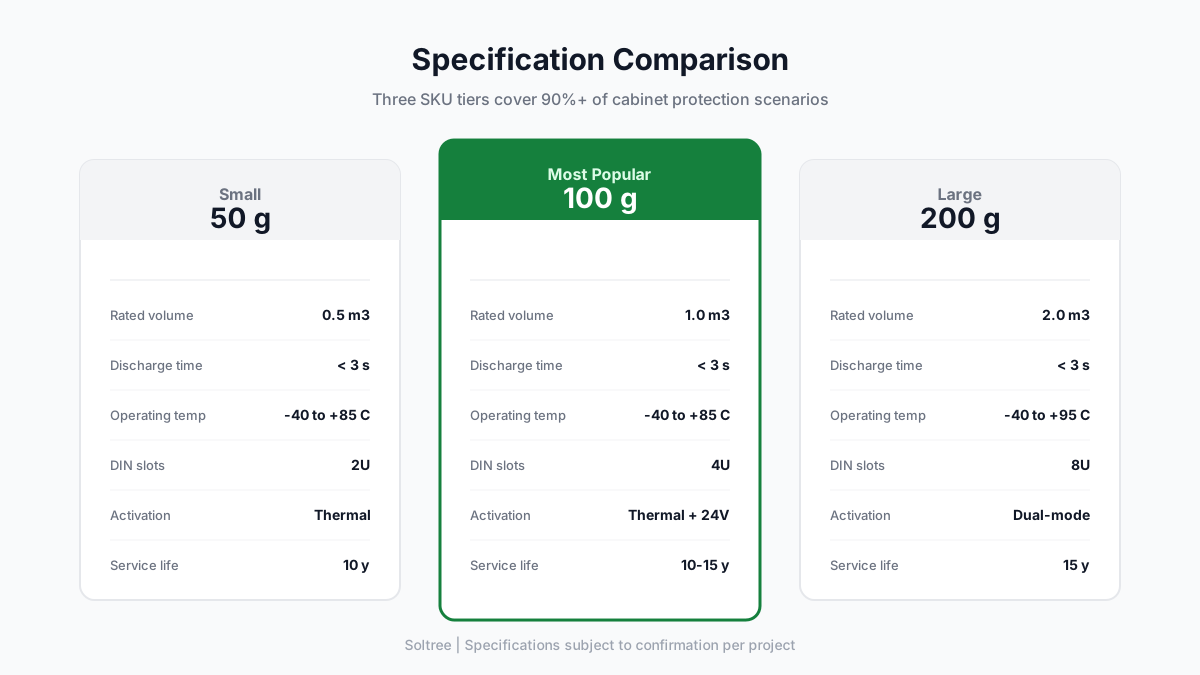
Agent mass — the weight of aerosol-forming compound inside the canister — directly determines the protected volume. Common SKUs ship at 20 g, 50 g, 100 g, 200 g, and 500 g. As a rough rule of thumb, 1 g of agent protects roughly 0.01 m³ (10 L) of cabinet volume at the standard 100 g/m³ design concentration. A 100 g unit therefore covers a typical 1 m³ low-voltage distribution cabinet.
Design Concentration
The design concentration is the agent-mass-to-volume ratio required to extinguish the relevant fuel class. The reference figures most factories design around:
- 100 g/m³ — Class A surface fires (cable insulation, plastics)
- 120 g/m³ — Class B liquid fires (oil-filled equipment)
- 140 g/m³ — high-risk lithium-battery enclosures (rising standard for BESS)
Always confirm which value the supplier's tested concentration is — published "rated volume" figures are sometimes calculated against the lowest concentration without disclosure.
Activation Modes
There are three activation architectures:
- Thermal-only — a glass bulb breaks at a rated temperature (typically 70 °C, 93 °C, or 110 °C). Simplest, no wiring required, fully autonomous.
- Electric-only — fired by a 24 V signal from a fire-detection panel. Required when integration with building management or BESS BMS is needed.
- Dual-mode (thermal + electric) — both paths active. Highest reliability; standard for safety-critical applications.
Discharge Time
Industry-grade units discharge in 3 seconds or less. Anything slower than 5 seconds in a cabinet-scale enclosure raises questions about the agent grain geometry or compound formulation. Insist on seeing the discharge curve from the test report, not just the peak number.
Operating and Storage Temperature
Standard operating range is −40 °C to +85 °C, with extended-range SKUs available to +95 °C for outdoor BESS containers. Storage temperature matters too: shipments crossing the equator should specify SKUs validated to +95 °C container conditions to avoid premature thermal degradation.
Service Life
Reputable manufacturers warrant 10 years from date of manufacture, with some now extending to 15 years on premium SKUs. The limiting factor is typically the thermal bulb or the electric initiator's shelf chemistry, not the aerosol compound itself.
Form Factor and DIN Slot Count
Standard form factors:
- 1U (18 mm) — equivalent to a single MCB; lowest agent mass (typically up to 30 g)
- 2U (36 mm) — most popular SKU for distribution panels
- 4U or larger — for higher agent masses and larger cabinets
When a project requires multiple cabinets of varying volumes, standardizing on two SKUs (small + medium) usually covers more than 90% of the cabinet population without inventory complexity.
OEM, ODM, and Customization Options
Most Chinese manufacturers in this category accept three tiers of customization. Understanding which tier a project actually needs prevents both overpaying for unnecessary engineering and underspecifying for a brand-critical deployment.
Tier 1 — Private Label / White Label
The product is technically standard. Customization is cosmetic only:
- Custom logo and brand name on the housing label
- Bilingual or multilingual instruction labels
- Custom packaging: branded box, multilingual user manual, custom inner trays
- Custom color on the housing (within available molded colors)
Typical MOQ: 300–500 units. Lead time: 30–40 days. Tooling cost: minimal to none.
Tier 2 — OEM with Mechanical or Electrical Changes
The product platform is standard, but specific modules are reconfigured:
- Different activation thresholds (for example, 88 °C bulb instead of 93 °C)
- Custom electrical interfaces (specific connector types, monitoring contacts, end-of-line resistors)
- Custom status LED color or behavior
- Reinforced housing for marine or rail-grade vibration
Typical MOQ: 1,000–2,000 units. Lead time: 45–60 days. Tooling cost: USD 1,500–8,000 depending on scope.
Tier 3 — Full ODM
A new product platform is developed against the customer's brief. Examples include integrated Modbus-RTU monitoring, novel form factors, or proprietary agent formulations for specialized fuel classes.
Typical MOQ: 5,000+ units or NRE recovery agreement. Lead time: 4–9 months including type testing and certification. Cost: project-by-project.
What Cannot Be Customized
The agent's core chemistry, the ratio between fuel and oxidizer, and the safety-critical separation between the initiator and the agent grain are not customizable on a project basis. Any factory willing to "tune" these for a quick order is a red flag.
Certifications You Cannot Skip
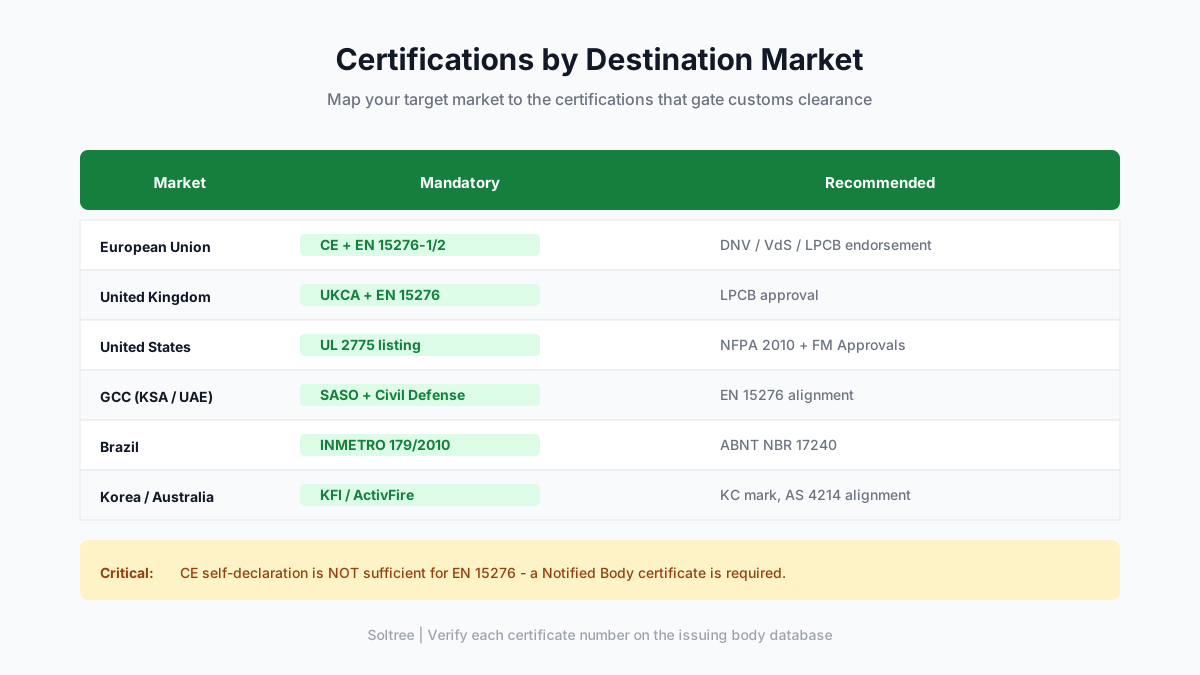
Certification gaps are the single most common reason a sourcing project derails after units have already shipped. Customs in the EU, the UK, GCC states, and Brazil routinely seize non-compliant aerosol extinguishers — at the importer's expense. Below is the certification matrix mapped to the markets where it actually matters.
| Target market | Mandatory | Strongly recommended |
|---|---|---|
| European Union | CE marking + EN 15276-1 (component) + EN 15276-2 (system) | DNV, VdS, or LPCB endorsement; REACH compliance dossier |
| United Kingdom | UKCA marking + EN 15276 equivalency | LPCB approval |
| United States | UL 2775 listing | NFPA 2010 design alignment; FM Approvals for insurance leverage |
| Canada | UL 2775 (cULus) | ULC-S560 alignment |
| GCC (Saudi Arabia, UAE) | SASO + Civil Defense approval | EN 15276 |
| Brazil | INMETRO Ordinance 179/2010 | ABNT NBR 17240 |
| Korea | KFI (Korea Fire Institute) approval | KC mark |
| Australia / NZ | ActivFire scheme listing | AS 4214 alignment |
| Mainland China | CCC + 3C fire certification | GB 25972 alignment |
Critical: "CE self-declaration" is not sufficient for EN 15276 products in the EU. EN 15276 requires a Notified Body certificate (Module B + Module D) and a valid annual factory production control audit. If a supplier offers only a self-issued Declaration of Conformity, the goods are non-compliant on arrival.
How to Verify a Certificate
- Ask for the certificate number and the issuing Notified Body number (for example, NB 0036 for TÜV SÜD)
- Cross-check on the official Notified Body database
- Confirm the product model number on the certificate matches the model in your PO exactly — generic family certificates are sometimes misrepresented as covering specific SKUs
How to Vet a Chinese Supplier
The single highest-leverage activity in a sourcing project is supplier due diligence. A weekend of structured vetting prevents a six-month dispute. Below is the framework we recommend, broken into documentary, technical, and behavioral checks.
Documentary Checks (Must-Have)
Request and verify, in this order:
- Business license — verify on the State Administration for Market Regulation portal. Confirm the registered business scope explicitly includes fire equipment manufacturing, not just trading.
- ISO 9001:2015 certificate — current and issued by an IAF-accredited body.
- Original test reports for the specific SKU you're buying — issued by an accredited lab (such as TÜV, SGS, Intertek, or a CNAS-accredited Chinese lab). Reports must show the model number, test date, and the lab's stamp.
- Export license / CIQ registration for hazardous goods (UN 3268).
- Product liability insurance certificate with coverage of at least USD 1 million per occurrence.
- Factory address verification — cross-check the address on the business license against the address on the test reports and quality certificates. Mismatches almost always indicate a trading company posing as a manufacturer.
Technical Checks
- Live or recorded discharge video of the specific SKU you're buying. Reputable manufacturers post these openly; if a supplier won't share one, walk away.
- Production capacity verification — request monthly output figures for the last 12 months and cross-reference against the certified production line capacity on the ISO certificate.
- Sample testing — order 5 to 10 sample units. Send 2 to 3 to a third-party lab for independent verification of agent mass, discharge time, and activation temperature.
On-Site or Remote Audit
For orders above USD 50,000 or any project intended for safety-critical applications (BESS, transit, healthcare), a third-party factory audit is non-negotiable. Established options:
- SGS, TÜV SÜD, Bureau Veritas, Intertek — full audits, USD 800–1,800 per day
- Remote video audit (live walkthrough by a local agent) — USD 200–500, sufficient for second-tier suppliers
- Customer self-audit — viable when at least one team member can physically visit and read Chinese; allow 1.5 days on site
Red Flags That Should Kill a Deal
| Red flag | Why it matters |
|---|---|
| Quoted price more than 30% below the market floor | Suggests counterfeit components or skipped certifications |
| Refusal to provide raw test report (only the certificate) | Often indicates the certificate covers a different model |
| No own discharge test video | Suggests pure trading company, not a manufacturer |
| Factory address differs from license address | Trading-company red flag |
| Certificate issued by an unrecognized lab | Likely not accepted at destination customs |
| MOQ stated in quotation differs from MOQ in PI | Negotiation manipulation; expect more downstream |
| "We can ship as ordinary goods, not dangerous goods" | Customs fraud; importer is liable |
Pricing Structure: FOB, CIF, and Volume Tiers
Pricing is the question every buyer arrives with and the question every supplier deflects. The honest answer is that there is no single FOB price for a din rail aerosol fire extinguisher, because at least nine variables move the number. Below is the cost structure, reference ranges, and the variables you should be asking about in any quote conversation.
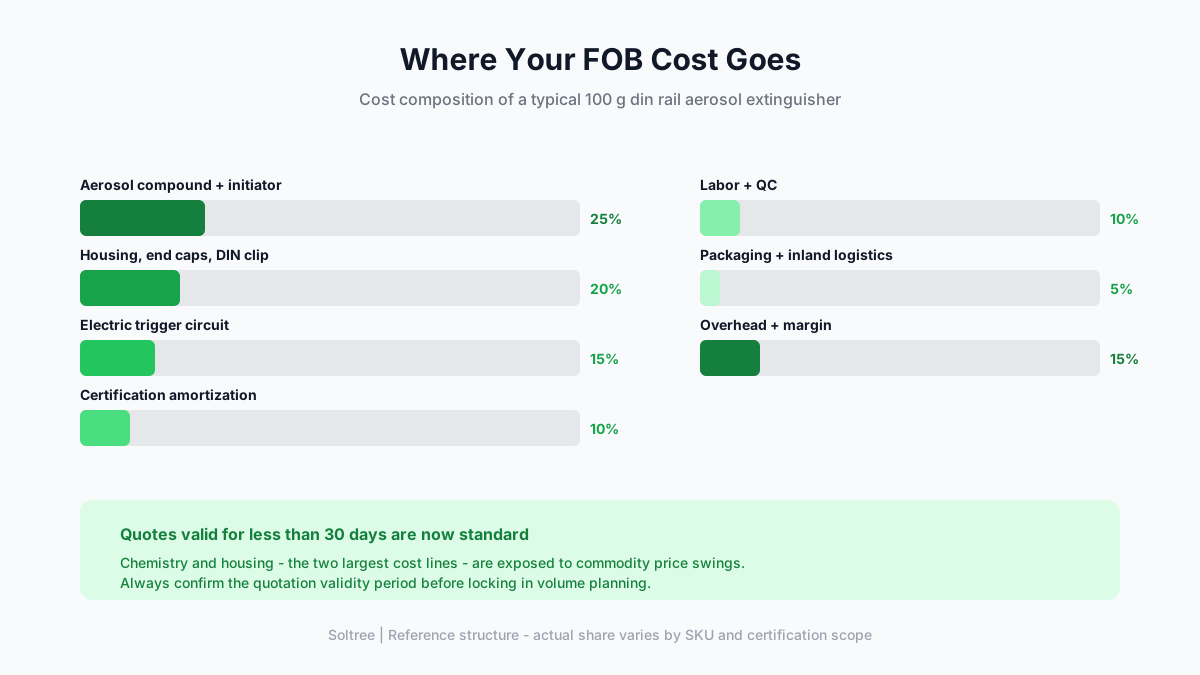
Cost Structure of a Typical 100g Unit
A representative breakdown of where the FOB cost goes:
| Component | Share of cost |
|---|---|
| Aerosol-forming compound + initiator | ~25% |
| Housing, end caps, DIN clip | ~20% |
| Electric trigger circuit (where fitted) | ~15% |
| Certification amortization | ~10% |
| Labor + QC | ~10% |
| Packaging + inland logistics | ~5% |
| Overhead + margin | ~15% |
The two largest line items — chemistry and housing — are also the two most exposed to commodity price swings. Quotes valid for less than 30 days are increasingly common for this reason.
Reference Price Bands (FOB China, Indicative, Mid-2026)
These bands assume CE EN 15276 plus UL 2775 dual-certified product, thermal activation, standard housing, and order quantities at the volume tier shown. These are reference indicators only — actual pricing depends on specifications, certifications, and current commodity costs. Request a quotation for your exact requirement.
| Agent mass | 100 units | 500 units | 2,000 units | 10,000+ units |
|---|---|---|---|---|
| 20 g | Band A++ | Band A+ | Band A | Band A- |
| 50 g | Band B++ | Band B+ | Band B | Band B- |
| 100 g | Band C++ | Band C+ | Band C | Band C- |
| 200 g | Band D++ | Band D+ | Band D | Band D- |
| 500 g | Band E++ | Band E+ | Band E | Band E- |
Volume Discount Tiers
Most factories operate roughly to this scale on standard SKUs:
- 100–499 units: list price
- 500–1,999 units: ~5–10% off
- 2,000–4,999 units: ~10–18% off
- 5,000–9,999 units: ~18–25% off
- 10,000+ units: bespoke; expect tooling-amortized pricing
Hidden Costs to Budget For
Buyers consistently underestimate four line items:
- Test report fees (USD 800–4,000 per SKU per market) — usually borne by the buyer for first-time SKU certification
- Mold and tooling fees (USD 1,500–8,000) — for OEM cosmetic changes
- Marine insurance for hazardous goods (typically 0.6–1.2% of FOB value, versus 0.2% for general cargo)
- Dangerous goods documentation (DG declaration, MSDS translation, UN box certification) — often USD 150–400 per shipment
FOB vs CIF vs DDP — Choosing the Right Incoterm
- FOB (port of origin) — best when you have a competent freight forwarder and want maximum cost transparency.
- CIF (named port of destination) — convenient but typically embeds 5–10% margin on the freight portion. Worth it for low-volume buyers who lack forwarder relationships.
- DDP (delivered duty paid) — only attractive when the supplier has demonstrable experience with your destination's hazardous-goods customs procedures. Ask for the customs broker's name and license number before agreeing.
Ready to scope a specific quote? Our team will return a detailed quotation within one business day, including reference pricing, certification scope, lead time, and Incoterm options for your destination. Request a quotation here.
MOQ, Lead Time, and Shipping
Operationally, three numbers govern every project: minimum order quantity, lead time, and shipping window. The combinations that work and the combinations that fail are well-mapped at this point.
MOQ Realities
- Standard SKUs (no customization): 100 units is realistic; some factories will go to 50.
- Custom labeling or packaging: 300–500 units.
- Custom mechanical or electrical changes: 1,000–2,000 units.
- Full ODM: 5,000+ units or NRE recovery.
Buyers below MOQ have two viable paths: (1) buy from a factory's existing stock SKU and brand it with a separate label, or (2) consolidate orders across multiple destinations to clear MOQ collectively.
Realistic Lead Times
| Order type | Production | Notes |
|---|---|---|
| Stock SKU, in inventory | 5–10 days | Ex-works |
| Standard SKU, made-to-order | 25–35 days | Most common case |
| OEM (logo, packaging) | 35–45 days | First-order tooling adds 7–10 days |
| OEM (mechanical or electrical) | 50–70 days | Sample approval cycle adds 10–15 days |
| Full ODM | 4–9 months | Includes type testing |
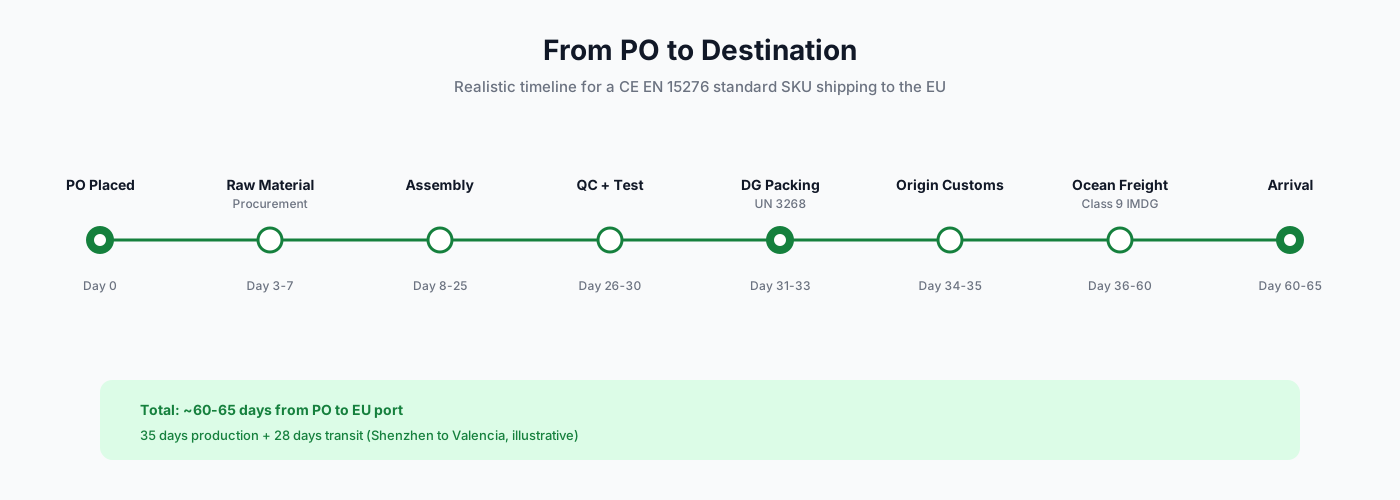
Add 15–35 days transit for ocean freight to the EU and Mediterranean, 20–40 days to North American west and east coasts, and 35–55 days to South America. Air freight typically lands in 5–8 days but is rarely cost-effective above 50 kg of dangerous goods.
Hazardous Goods Classification
Din rail aerosol fire extinguishers are classified as UN 3268, Class 9 dangerous goods (Safety devices, electrically initiated) under IMDG and IATA Dangerous Goods Regulations. Practical implications:
- Sea freight: standard 20-foot or 40-foot containers acceptable; book through a forwarder with IMDG endorsement. Expect 0.6–1.2% insurance premium versus general cargo.
- Air freight: requires IATA DGR-compliant packaging (UN-certified fiberboard boxes) and a Shipper's Declaration. Many passenger carriers refuse Class 9 of this type; freighters are required for larger consignments.
- Customs: HS code is typically 8424.10.0090 for the device; the dangerous-goods classification is layered separately.
Shipping Document Checklist
A complete export shipment will include:
- Commercial invoice
- Packing list
- Bill of lading or air waybill
- Material Safety Data Sheet (MSDS) in destination language where required
- Dangerous Goods Declaration (DGD)
- UN-approved packaging certificate
- Certificate of origin (Form A or RCEP, depending on agreement)
- Test report or product certificate copies
- Insurance certificate (CIF or CIP terms)
Missing any one of these typically costs 3–7 days at destination customs.
Installation and Commissioning Overview
For most procurement teams, installation is the contractor's problem — but knowing the steps shortens the technical conversation with end users and exposes any specification gaps before they become field disputes.
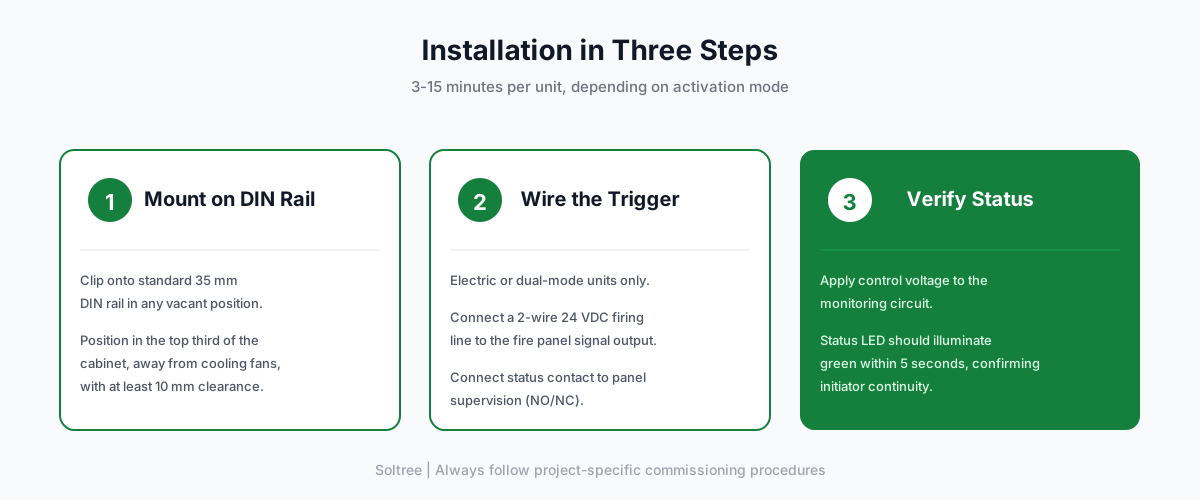
The Three-Step Install
- Mount on DIN rail. The unit clips onto a standard 35 mm DIN rail in any vacant position inside the cabinet. Position recommendations: top-third of the cabinet, away from cooling fans, with at least 10 mm clearance around the discharge opening.
- Wire the trigger (electric or dual-mode units only). A two-wire 24 VDC firing line connects to the fire-detection panel's signal output. Most units include a status contact (NO/NC) that reports back to the panel for supervision.
- Activate status indication. Apply control voltage to the unit's monitoring circuit. The status LED should illuminate green within 5 seconds, confirming the initiator continuity is intact.
Total install time per unit: 3–8 minutes for thermal-only models; 8–15 minutes for electric or dual-mode models including loop testing.
Maintenance Regime
Reputable units are designed for functional maintenance-free operation across their service life. Best-practice site procedures include:
- Annual visual inspection — confirm the status LED is green and there is no visible damage
- Annual control-loop test — for electric units, simulate a fire signal at the panel and confirm the unit's monitoring contact responds correctly (do NOT actually fire the unit)
- Decennial replacement — replace the entire unit at the end of its rated service life (typically 10 years)
End-of-Life Disposal
Expired units that have not discharged remain Class 9 hazardous goods and must be disposed of through a licensed hazardous-waste handler. Discharged units are typically treated as ordinary industrial waste once the residue has been wiped down — confirm with your local waste regulator.
Case Study: 50 MW Solar Farm Deployment
The following is a representative project description based on typical deployment patterns. Specific figures are illustrative.
Background
A European EPC contractor specializing in utility-scale solar was awarded a 50 MW project in southern Spain. The project specification required cabinet-level fire suppression in every DC combiner box and string inverter cabinet, driven by the project's insurance carrier following a sister project's combiner-box fire eighteen months earlier.
Specification Challenge
The project required:
- Approximately 1,800 combiner-box units (each 0.4 m³ enclosed volume)
- Approximately 200 inverter-cabinet units (each 1.6 m³ enclosed volume)
- Operating temperature qualified to +85 °C ambient (Spanish summer interior)
- Full CE EN 15276 documentation for project sign-off
- Delivery to site within a 14-week window from order placement
Sourcing Decision
After evaluating four EU manufacturers and three Chinese manufacturers, the EPC selected a Chinese supplier with the following profile:
- CE EN 15276 + UL 2775 dual certification verified through Notified Body database
- Annual production capacity of 240,000 units (verified by remote audit)
- Three years of EU project deliveries with documented zero in-warranty failures
- FOB price approximately 47% below the lowest EU quote
- Lead time quote of 35 days production + 28 days transit (Shenzhen to Valencia)
Outcome
- 2,000 units delivered to site on schedule
- Total landed cost reduced by approximately 38% versus the EU benchmark
- Project commissioning completed on the original timeline
- Zero rejections at customs or site QA
Key Takeaways
- Dual certification (CE + UL) shortcuts the supplier shortlist dramatically — fewer than 15 Chinese factories meet this bar today.
- Verified production capacity is more predictive of on-time delivery than verbal lead-time commitments.
- Pre-shipment third-party inspection (around USD 0.15 per unit at this volume) added negligible cost and removed all field-quality risk.
Frequently Asked Questions
Are din rail aerosol fire extinguishers safe for occupied spaces?
Modern condensed aerosol products are formulated to be safe for occupied spaces in the typical concentrations used inside cabinets, and EN 15276-certified products are tested for human-occupied safety. That said, evacuation of personnel from any enclosed protected volume during discharge is still recommended best practice. Always confirm the specific product's occupancy classification in its declaration of performance.
Do they require recharging after activation?
No. A din rail aerosol extinguisher is a single-use device. After it has discharged, the entire unit is replaced. There is no field-rechargeable version of this product class.
What's the difference between aerosol and clean agent (FM-200)?
FM-200 (HFC-227ea) is a halocarbon clean agent stored as a liquefied gas under pressure, requiring a piped distribution network and a sealed enclosure. Condensed aerosol is a solid compound that combusts on activation to produce fine particles, requires no pipework, and works in less-sealed enclosures. Aerosol is typically 60–80% lower cost on a per-cabinet basis but is generally specified for smaller protected volumes.
Can I import them to the EU without an EU representative?
Under the current EU CPR and Machinery framework, products requiring CE marking must have an EU-based responsible person — either the manufacturer's EU subsidiary or an authorized representative — designated on the declaration of conformity. Importers should verify this designation exists before shipping; otherwise customs may detain the goods.
What's the typical warranty?
Standard manufacturer warranty in this category is 24 months from date of shipment for material defects, with the rated service life (10 years standard) covering functional reliability under normal storage and operating conditions. Premium suppliers extend warranty to 36 months or align it with the device's full service life on enterprise contracts.
Do they work in unsealed enclosures?
Aerosol systems tolerate more enclosure leakage than gaseous clean agents but are not fully insensitive to it. As a rule of thumb, the cabinet should hold the agent concentration above the design value for at least 10 minutes — typically achievable in cabinets with leakage area below 1% of total surface area. For highly louvered enclosures, agent mass should be over-specified or a different suppression technology considered.
Are they classified as dangerous goods for shipping?
Yes. Din rail aerosol fire extinguishers are classified under UN 3268, Class 9 (Safety devices, electrically initiated) for transport under IMDG and IATA regulations. They require UN-certified packaging, a Dangerous Goods Declaration, and shipping through forwarders licensed to handle Class 9 cargo.
Can I use one extinguisher for multiple cabinets?
A single unit protects one enclosed volume. Across multiple separate cabinets, separate units are required — even if the cabinets are physically adjacent — because each enclosure traps the agent independently. Adjacent cabinets joined through a sealed interconnection (such as a busway) may be treated as a single volume on a project-specific basis.
What's the shelf life before installation?
Standard shelf life from date of manufacture is 24 months before installation (after which the rated service life clock starts). Storage conditions: dry, between −10 °C and +40 °C, away from direct sunlight, in original packaging.
How do I dispose of expired units?
Expired but undischarged units remain Class 9 hazardous goods and must be returned to a licensed hazardous-waste handler. Many manufacturers and distributors offer take-back programs at end-of-life — confirm at the point of order whether this service is available in your destination country.
Closing: Three Decisions That Define a Successful Sourcing Project
After working through the technology, the certifications, the pricing, and the logistics, the buying decision condenses to three commitments worth making before a quote is even requested.
First, decide your certification bar before you shortlist suppliers. A buyer who decides "CE + UL minimum" upfront eliminates 80% of the noise on the first email round.
Second, set a realistic MOQ and lead-time envelope based on your destination market's compliance requirements, not on the lowest quoted price. The cheapest supplier who can't deliver paperwork is more expensive than the second-cheapest who can.
Third, invest in vetting in proportion to deal size. A USD 5,000 trial order can be vetted through documents and a video call. A USD 500,000 project deserves a third-party audit and pre-shipment inspection — costs that will look small the moment the first container clears customs without incident.
Continue Reading
For deeper context on each phase of the sourcing decision, the cluster below maps to the buying journey from technology orientation through pre-PO verification:
- Technology foundation: What is a din rail aerosol fire extinguisher? — chemistry, components, and where the category fits
- How it actually works: How aerosol fire extinguishers stop electrical-cabinet fires — suppression mechanism plus three field case studies
- Where it ships: Top 8 applications driving 2026 demand — market sizing and distributor margin per vertical
- Technology comparison: Aerosol vs FM-200 vs CO₂ vs Novec 1230 — when each suppression technology is the right answer
- Sizing methodology: How to size a din rail aerosol fire extinguisher — the EN 15276 formula and worked examples
- Pre-PO spec audit: Datasheet specifications buyers must verify — the 18-parameter check list
- Certification deep-dive: CE, UL, EN 15276 & CCC explained for importers — fraud patterns and verification process
- Reference pricing: 2026 FOB price guide — tiered ranges, MOQ ladder, and TCO modeling
- Final pre-PO checklist: The ultimate buyer's checklist (2026) — 122 verification points across 8 dimensions
Soltree manufactures CE EN 15276 and UL 2775 certified din rail aerosol fire extinguishers, with active deliveries in over 80 countries. Browse our flagship DIN Rail Thermal Aerosol Fire Extinguishing Device (10 g / 20 g / 30 g variants) for full specs, datasheets, and certification documentation. Whether you need 100 units for a single project or 50,000 units annually for distribution, our team will return a detailed quotation within one business day. Contact our team with your project requirements and receive a factory-direct quote within 24 hours.
Factory Direct · OEM Available
Ready to Source? Get a Factory-Direct Quote.
- ✓Wholesale pricing with full CE & TUV documentation
- ✓OEM & private label — custom spec, your brand
- ✓Samples, datasheets & tech support on request